Insta360 released the X6 on August 12, 2026, and its front panel creates a new sourcing problem for accessory buyers. The camera uses a 2.32-inch OLED screen, a peak brightness of 1,200 nits and an under-display pressure sensor. The previous-generation X5 has its own body, display and control layout. An Insta360 X6 screen protector therefore has to be treated as a new tooling project, not as an X5 film with a new label.
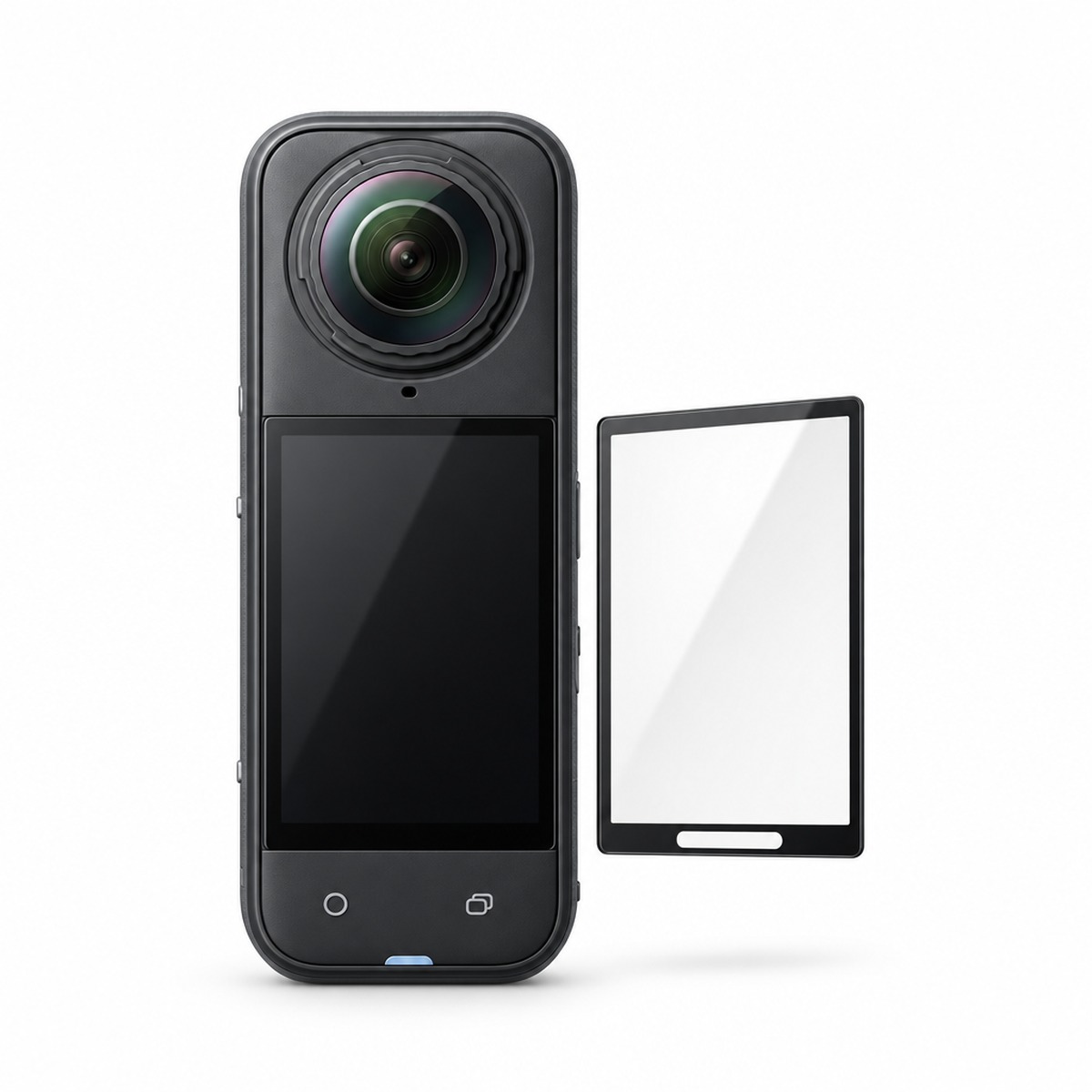
The sourcing question is not simply whether glass can be cut to the approximate size. It is whether the finished part preserves pressure-to-record control, follows the display edge, stays attached during handling and presents the OLED image without avoidable haze. Those checks belong in the sample stage, before a purchase order is placed.
What Changed on the Insta360 X6
Insta360’s official product page describes a camera built around dual custom 1/1.1-inch square Sony sensors, native 8K50fps 360 video and a compact body. The front-panel changes are the part that matters for a screen-protection program.
| X6 front-panel feature | Official detail | Sourcing consequence |
|---|---|---|
| Display | 2.32-inch OLED | The outline, corner radius and visible area need new tooling |
| Peak brightness | 1,200 nits | Brightness helps outdoor preview; it does not remove reflections by itself |
| Input | Under-display pressure sensor | Press-to-record must be tested after the film is applied |
| Camera class | Compact 360 camera with replaceable lenses | Edge clearance and accessory fit need checking around the body and lens area |
The new display is close enough in size to invite a shortcut and different enough in construction to punish one. A 2.32-inch OLED panel in an X6 body is a separate mechanical specification from the previous generation. Buyers should ask for an X6-specific drawing, not a supplier statement that an X5 film “should fit.”
Why an X5 Die Should Not Be Reused
Model-to-model reuse is sensible only when the cover glass, active display area, border geometry and interaction method are unchanged. The X6 changes the display size and panel technology. It also moves recording control to a pressure sensor beneath the screen.
That creates four procurement risks:
- Outline error. A film cut for the X5 can cover part of the X6 bezel or leave a visible strip at one edge.
- Pressure-control interference. A sample that looks correct can still feel different when the user presses the screen to start or stop recording.
- Optical mismatch. An OLED panel has different black levels and contrast from an LCD. A film with unnecessary haze or a strong matte finish is easier to notice during preview and playback.
- Edge lifting. A new body, curved edge or accessory clearance can change how the film sits. A flat sample on a desk does not prove long-term fit on the camera.
A reliable supplier will want the device, approved 3D data or a dimensioned drawing before committing to a die. If the only input is a marketing photo, the first sample is a guess.
Clear, AR or Matte: Choose for the Way the Screen Is Used
The X6 screen is a working display for framing, playback and menu control. It is not a phone screen watched from a fixed angle. Film selection should follow that use.
| Film type | Main benefit | Trade-off to disclose | Suitable program |
|---|---|---|---|
| HD clear tempered glass | Preserves colour and detail; straightforward retail message | Shows reflections and fingerprints first | Default SKU for image-quality-led buyers |
| AR anti-reflective glass | Reduces surface reflection while keeping the image clear | Higher coating cost; specification must be checked | Premium kit for outdoor creators and professional users |
| Matte AG film | Diffuses glare and feels less slippery | Can soften fine preview detail and reduce contrast | Buyers targeting glare-heavy outdoor use |
The 1,200-nit peak brightness helps the X6 remain readable in bright conditions. It does not make every film suitable. A glossy film can still reflect a bright sky, and a heavy matte film can still make a small preview look softer. The buyer should decide which compromise belongs in the product listing before the factory fixes the coating.
For a B2B range, clear glass is usually the first volume SKU, with AR or matte as a second variant. That sequence keeps the core offer easy to explain and leaves the specialist film for buyers who can support the higher cost and narrower use case.
The Sample Validation Checklist for X6
A physical sample fitted to the actual camera is the minimum evidence. A rendering and a generic action-camera film are not enough. Validate the following before approving bulk production.
- Outline and cutouts. Confirm the full perimeter, corner radii, camera or sensor clearances and any opening required by the body.
- Pressure control. Enable press-to-record, then test multiple presses across the screen, including with gloves if that is a claimed use case. The action must remain reliable and must not trigger accidentally.
- Touch and menu response. Check taps, swipes and menu selection at the centre and near the edges. A film can look perfect and still create a dead-feeling edge.
- Optical quality. View a bright scene, a dark scene and a detailed menu. Look for haze, colour shift, rainbow effects and excessive reflection.
- Edge adhesion. Inspect the full perimeter immediately after application and after the camera has been carried, mounted and handled. Record any lift or trapped dust.
- Surface feel. Confirm that the oleophobic treatment reduces drag and makes fingerprints easy to wipe away.
- Removal and residue. Apply and remove a sample following the intended user instructions. Check that the adhesive releases cleanly and does not leave a difficult residue.
- Packaging and instructions. Match the pack to the channel: bulk film only, two-piece retail pack or a kit with wipes, dust removal and an alignment tool.
Document the result with photos and measured values. “Customer approved” is not a specification; a signed sample report is.
Common Mistakes in an Action-Camera Film Program
The first mistake is treating the X6 as a color variant of the X5. The second is approving a film from a photo of the camera rather than a fitted sample. Other problems appear later:
- specifying a thick decorative glass without testing the pressure sensor;
- copying the screen protector from a different action-camera model because the diagonals look similar;
- ignoring the difference between the visible display and the full cover-glass area;
- choosing a matte finish for a product listing that promises maximum preview clarity;
- packing a film that needs careful alignment without an installation tool or clear instructions;
- changing adhesive or coating between the approved sample and mass production without telling the buyer.
For a distributor, these are not factory details that can be left to the supplier. They determine return rates, installation complaints and whether the accessory supports the camera’s advertised controls.
How kmore Approaches a New Action-Camera Model
kmore Optical is a screen-protector manufacturer in Dongguan, Guangdong, China, established in 2015. For the existing Insta360 X5 curved-edge program, the film is cut 1:1 from the device and produced with 0.33 mm high-alumina silicate tempered glass, 9H surface hardness, edge adhesive, an electroplated oleophobic coating and a 2.5D curved edge. Standard transmittance is above 90%, with an HD version available.
The X5 remains on sale alongside the X6, so a distributor's range should keep the X5/X4 screen film and the matching lens protectors in stock while the X6 program is being sampled. Order against the model list you actually carry rather than a generic "action camera" SKU.
For a new model such as the X6, the process starts with a physical device or approved dimensional data, followed by an X6-specific drawing and a fitting sample. The buyer should approve pressure control, touch response, optical quality and edge adhesion on the actual camera before tooling is released for bulk production. Film type, cutout, edge finish and packaging are specified as one production package so the sample and the shipment describe the same product.
The current action-camera range is listed under action camera screen protectors. Buyers who are comparing suppliers can also read our guide to choosing a screen protector supplier in China, which covers tooling, inspection and sample control.
FAQ
Q: Can I use an Insta360 X5 screen protector on the X6? A: Do not assume so. The official specification lists a 2.32-inch OLED screen on the X6, while the X5 is a different generation with its own body and display geometry. The outline, edge geometry and pressure-sensor interaction need to be validated on an X6-specific sample.
Q: Will a tempered glass film stop the X6 pressure-to-record function? A: A correctly designed full-adhesive film may preserve the function, but it must be tested on the actual camera. Press the screen in several positions, including with gloves if that is part of the product claim, before approving bulk production.
Q: Is AR glass always better than clear glass for the X6? A: AR glass reduces surface reflection and can suit outdoor preview, but it costs more and must meet the stated optical specification. Clear glass is easier to explain and is usually the better core SKU. The choice depends on the buyer’s price band and use case.
Q: Should the X6 use a matte screen protector? A: Matte film is useful when glare control matters more than fine preview detail. It can soften a small OLED preview and reduce perceived contrast, so the trade-off should be stated plainly in the listing rather than hidden behind a generic “anti-glare” claim.
Q: What should a bulk order include beyond the film? A: Agree on the film type, cutout, adhesive, surface coating, edge finish, pack format and inspection standard before production. A retail kit should also include the cleaning and alignment parts needed for a repeatable installation.
Send your X6 model plan, target quantity and preferred film type to kmore Optical for a sample discussion and quotation.