An iPhone Duo inner screen protector has to protect a 7.6-inch display that bends through the centre. The selection question is not only “clear or matte.” Buyers also need to choose the right surface treatment and the right installation-size version. kmore supplies two EPU finishes, Matte (AG) and AFAR, and each is available in a Simple version or an Alignment Tray version.
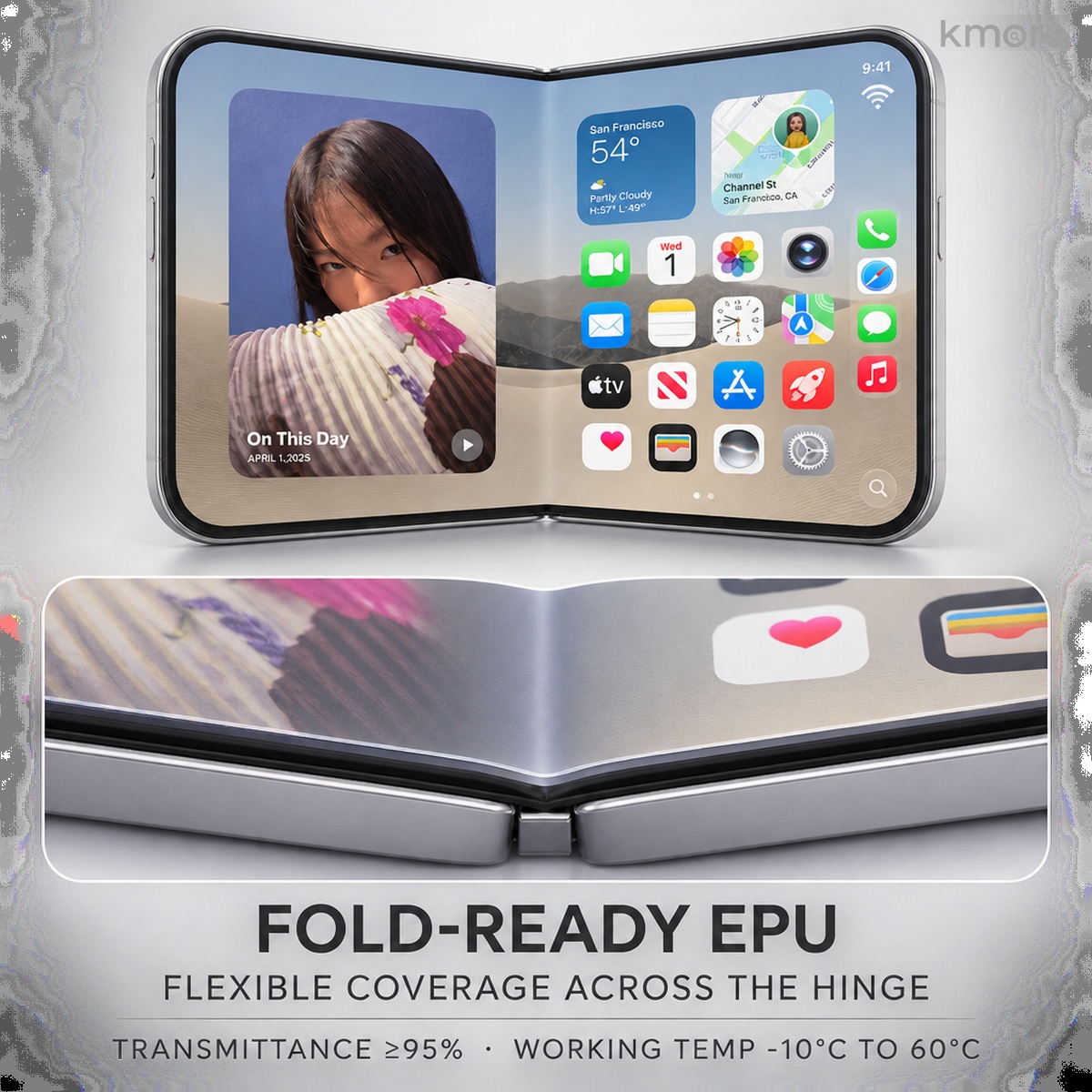
Product pictured: kmore iPhone Duo inner-screen EPU film. Final dimensions, camera positions and edge fit should be confirmed against the retail device.
The inner display needs a different film strategy
The iPhone Duo has a 7.6-inch inner display and a separate 5.4-inch outer display. Tempered glass is appropriate for the rigid outer panel, but the inner panel flexes. A practical inner-screen construction therefore needs a flexible use layer and an adhesive system that can remain continuous through the hinge area.
The central fold is the key qualification point. A sample should remain attached when the device is opened and closed, without lifting at the hinge, trapped air bubbles or a new hard crease introduced by the film. The supplied kmore TDS lists a working range of -10°C to 60°C for both surface options. It does not provide a fold-cycle count, so no cycle number is quoted here.
Matte (AG) versus AFAR
The two materials solve different viewing problems. Matte (AG) diffuses reflected light into a softer glow. AFAR combines anti-fingerprint and anti-reflective properties for a clearer, lower-reflection surface.
| Selection point | Matte (AG) | AFAR |
|---|---|---|
| Main visual effect | Soft matte, lower glare | Clear, low reflection |
| Screen appearance | Diffused, low mirror reflection | Clear with restrained reflections |
| Surface data in supplied TDS | Haze ≤40% | Haze ≤2%; reflectance ≤1.5% |
| Fingerprint positioning | Matte surface | Explicit anti-fingerprint feature; water contact angle ≥115° |
| Typical buyer brief | Soft-light finish with less mirror glare | Clear display with reduced fingerprint visibility |
| Shared TDS value | Transmittance ≥95% | Transmittance ≥95% |
Neither finish should be described as “no reflection.” The useful distinction is how the reflection is controlled. Matte (AG) spreads it across the surface; AFAR uses an anti-reflective approach and keeps the screen visually clearer.
Four SKUs, two products
The catalogue is organised by surface material, not by tool type. Each material product has two installation-size versions:
- Simple: a manually aligned film.
- Alignment Tray: a film sized for the supplied positioning tool and tray.
The use-layer material and surface finish are common within the same material option. The dimensions and supplied installation tool are what change. This structure lets distributors compare like with like, while still offering two installation experiences under one product page.
For MATTE, compare the Matte (AG) EPU film and its two versions. For clear low-reflection performance, compare the AFAR EPU film.
Technical-data comparison
The supplied TDS documents give buyers separate reference values for each surface. These are reference targets, not a substitute for the final SKU report.
| Item | MATTE / BODD-AG LR | AFAR / BODD-EPU 120AR |
|---|---|---|
| Reference model | BODD-FG100S | BODD-YSC0120AR FILM |
| Use-layer thickness | 100 ± 10 μm | 120 ± 10 μm |
| Light transmittance | ≥95% | ≥95% |
| Haze | ≤40% | ≤2% |
| Reflectance | — | ≤1.5% |
| Water contact angle | ≤100° | ≥115° |
| Working temperature | -10°C to 60°C | -10°C to 60°C |
| Shelf-life reference | 6 months below 65% RH at normal temperature | 6 months below 65% RH at normal temperature |
The AFAR TDS also describes a self-repair capability. It does not specify a repair time, so a responsible quotation should not promise “repairs within X hours.” Buyers can request sample observations and batch documentation before committing to packaging or volume.
What to test at the hinge
Approval should happen on the target retail device, not on a flat mock-up. Check:
- full coverage of the 7.6-inch inner display;
- alignment of camera, sensor and corner geometry;
- the film at the central fold through the full opening and closing motion;
- edge lifting, trapped air and surface deformation;
- screen clarity under the intended lighting;
- the selected Simple or Alignment Tray workflow with production operators.
The application method should also be checked against the packaging contents. If the buyer orders the Alignment Tray version, the supplied tray, film size and instruction sheet must match that version. A Simple-version photo should not be used as evidence for a Tray-version product.
Procurement checklist
Before requesting a quotation, confirm the surface, installation version, target quantity and packaging format. Then request a sample with the exact device model and retail configuration. For private-label projects, approve artwork and pack contents together with the physical sample.
Useful questions for the factory include:
- Is the quoted film matched to the 7.6-inch inner display and the chosen installation version?
- Which TDS values apply to the exact material in the quotation?
- Can the hinge area be demonstrated on the target sample?
- What changes between Simple and Alignment Tray besides size?
- What are the MOQ and lead-time assumptions for the requested packaging?
For the wider selection path, browse the iPhone Duo inner-screen category. Buyers comparing the full device protection route can also review kmore’s iPhone Duo foldable-screen sourcing guide.
FAQ
Is the iPhone Duo inner-screen protector suitable for the outer display? No. The 7.6-inch inner display and 5.4-inch outer display are different surfaces and need different product constructions.
Does Matte (AG) mean the screen becomes blurry? The aim is low glare while keeping content readable. The TDS lists haze ≤40% for the AG reference material; screen appearance should still be checked on an approved sample.
Can AFAR repair scratches? The supplied AFAR TDS states a self-repair capability but gives no time specification. Discuss the observed result on the sample and request batch data before making a timed claim.
Can I order one film that fits both installation versions? No. Simple and Alignment Tray are different installation-size versions. They share the same material finish within the chosen product but use different dimensions and tooling.
Can kmore supply private-label packaging? Yes, private-label packaging and OEM/ODM discussions are available. MOQ, pack contents, artwork and lead time are confirmed per order.
Request a sample or quotation through the kmore contact page with the chosen surface, installation version and target quantity.