
Apple announced the MacBook Pro with PROLED XDR Display on 28 October 2026: a tandem OLED panel in 14- and 16-inch models, up to 2,000 nits peak HDR and SDR brightness, a 10,000,000:1 contrast ratio, 120Hz variable refresh, and a nano-texture option etched into the cover glass. For anyone sourcing laptop privacy filters or anti-glare film, brightness and surface finish are not spec-sheet trivia — they change how a film behaves in daylight.
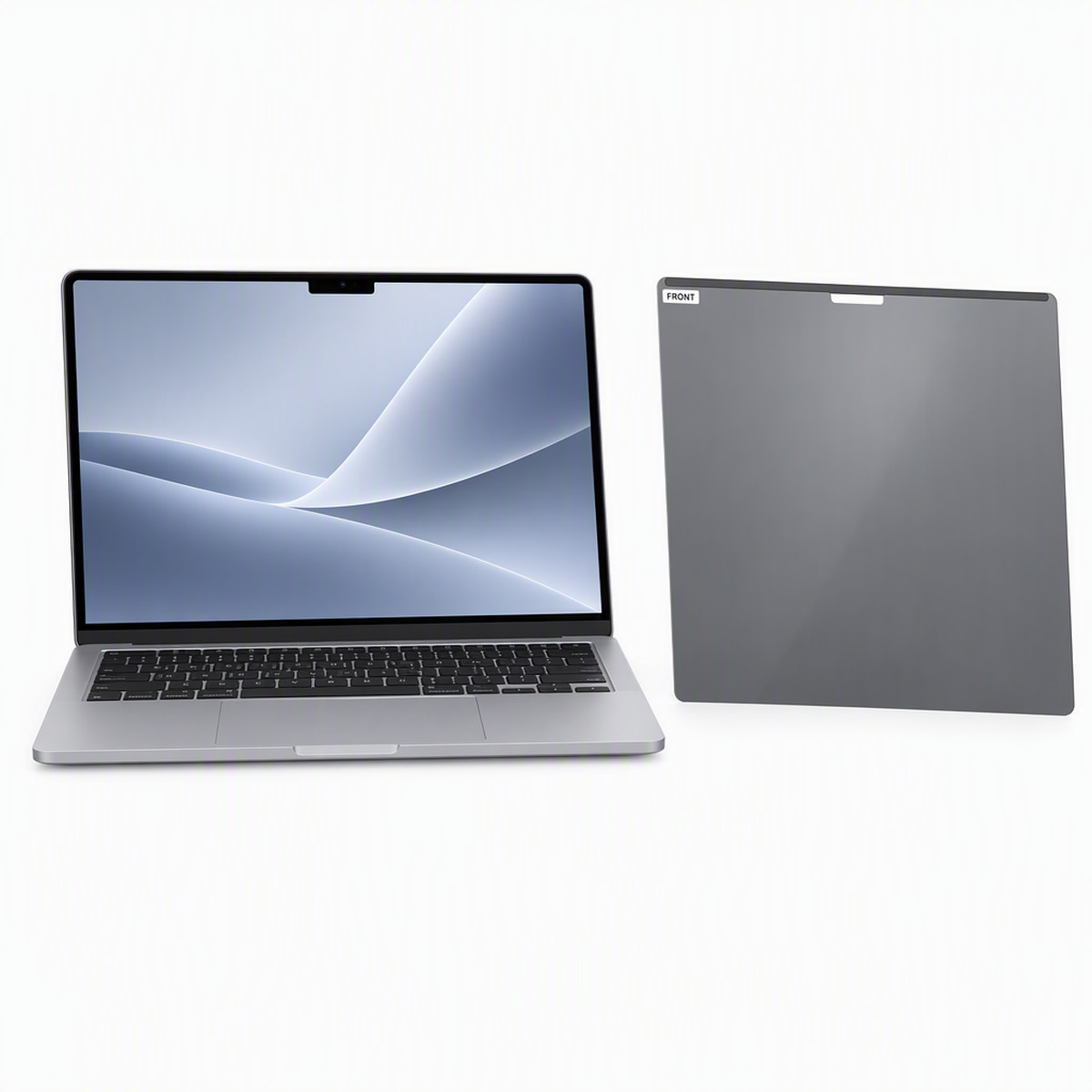
This note covers what changed, why a 2,000-nit OLED panel changes the film brief, and what to confirm before quoting a MacBook Pro accessory line.
What Apple changed
According to Apple’s press release, the new MacBook Pro uses tandem OLED technology in 14- and 16-inch sizes, with peak brightness up to 2,000 nits for both HDR and SDR content, a 10,000,000:1 contrast ratio, 120Hz variable refresh, and a wider colour gamut. The display carries an anti-reflective coating, and the nano-texture option is now etched directly into the cover glass rather than applied as a separate layer. The chassis is thinner and lighter, with M5 Pro and M5 Max chips.
Three of those details matter to a film supplier:
- Brightness: a brighter panel makes a privacy film’s “black” side easier to read through at an angle. The privacy layer has to hold its cut-off at higher luminance.
- Surface: nano-texture already scatters reflections. A matte film on top can double the diffusion and soften text.
- Size and thinness: 14- and 16-inch are different cut files, and a thinner lid changes how much edge thickness a filter can add.
Which film fits which buyer
| Film type | Best for | Watch-outs on the new MacBook Pro |
|---|---|---|
| Privacy filter (180°) | Corporate fleets, finance, healthcare | Check the cut-off angle at high brightness, not in a dim office |
| Privacy filter (360°) | Shared desks, open offices | Thicker stack; confirm the lid still closes flush |
| Anti-glare / matte | Glare-heavy offices | On nano-texture units, test sharpness before committing |
| AR film | Colour-critical work | Must not shift white point; measure before/after |
| Blue-light film | Long-session users | Verify the filtering range on a sample, not the datasheet |
For most accessory brands, the launch range is a 14-inch and a 16-inch privacy filter, plus one anti-glare SKU for corporate buyers. Colour-critical buyers usually want AR rather than privacy.
Why a 2,000-nit panel changes the privacy brief
A privacy filter works by blocking light outside a viewing cone. The brighter the panel, the more light leaks through that layer at an angle, so a filter that looks opaque on a 500-nit laptop can look grey on a 2,000-nit one. When you request samples, ask for the filter to be tested on the actual MacBook Pro at maximum brightness, viewed from the side at arm’s length, not on a test bench.
The same brightness affects anti-glare film. A matte film scatters light to reduce reflections, but on a very bright panel the scattering can also reduce perceived contrast. Test both a matte and an AR sample on the same unit and compare text edges, not just glare.
Tooling and order notes
- 1. Two cut files, not one. 14-inch and 16-inch are separate SKUs with separate tooling. Do not scale one drawing to the other.
- 2. Measure the lid, including the camera housing. The notch area and the hinge side are where filters lift.
- 3. Decide attachment before price. Adhesive strips, magnetic frames and slide-on tabs have different costs and different return rates.
- 4. Ask for the nano-texture unit for testing. A filter approved on the standard glass may fail on the etched version.
- 5. Set the packing rule early. Corporate buyers often want a cleaning cloth and an install card in the box; that changes carton size.
For a broader view of the category, our laptop privacy filter sourcing guide covers sizes, tooling and cost structure, and privacy film beyond phones explains where the same film is used on tablets and car displays.
How kmore handles a laptop launch
We build the cut file from a retail unit or a buyer drawing, then produce privacy and anti-glare samples on the same base film so the buyer can compare on the actual lid. For corporate orders we keep the attachment method and packing identical across the 14- and 16-inch SKUs, which keeps the quote stable and the install consistent. Send the target model and volume to our inquiry team and we will return a sample plan.
FAQ
Q: Does a privacy filter work the same on a 2,000-nit laptop?
A: It works, but the cut-off has to be validated at high brightness. A filter tested only in a dim office can look translucent outdoors.
Q: Can I use a matte film on the nano-texture MacBook Pro?
A: Test it first. Nano-texture already diffuses reflections; adding matte film can soften text further.
Q: Are 14-inch and 16-inch filters the same product?
A: No. They need separate cut files and usually separate tooling.
Q: What should a corporate buyer request in the sample?
A: The filter on the actual model at maximum brightness, viewed from the side, plus a cleaning cloth and install instructions if the box is part of the order.
Tell us the model mix and volume, and we will send a sample and tooling checklist for the 14- and 16-inch SKUs.